

Can Genius Weft be used for natural language processing? That's a question I've been getting a lot lately, especially since I'm a supplier of Genius Weft. At first glance, it might seem like a crazy idea. After all, Genius Weft is primarily known as a high - quality hair product. But let's dive into this and see if there's any potential here.
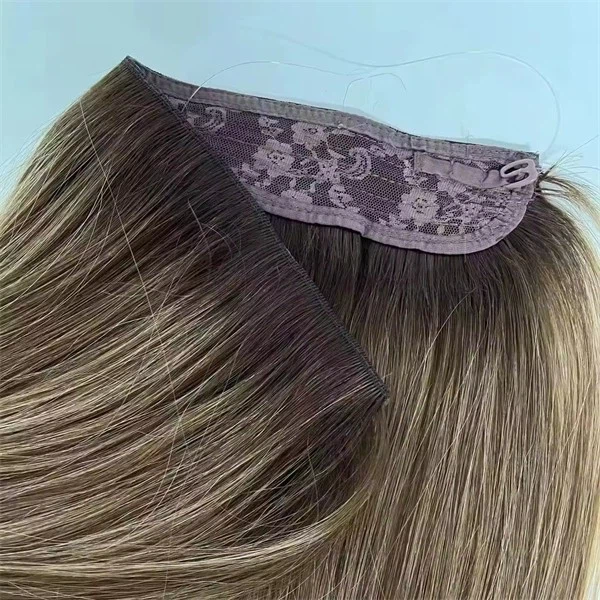
First off, let me introduce what Genius Weft is. If you're not familiar with it, you can check out the Genius Weft page for all the details. Genius Weft is a type of hair extension that offers a seamless and natural look. It's made from top - notch human hair, and it's very popular among people who want to add length and volume to their hair. The weft is designed to be easy to attach and blend in with your natural hair, making it a favorite in the hair industry.
Now, when we talk about natural language processing (NLP), we're dealing with a field of computer science that focuses on the interaction between computers and human language. NLP involves tasks like speech recognition, language translation, and text analysis. It's used in things like virtual assistants, chatbots, and search engines. So, how on earth could a hair product like Genius Weft have anything to do with NLP?
Well, the short answer is, directly, not much. But there are some indirect ways that the idea could be explored. For example, let's say a company that sells hair extensions, including Genius Weft, wants to improve its customer service. They could use NLP to analyze customer feedback. By using NLP algorithms, they can understand what customers are saying about the product, what they like, and what they don't like. This way, the company can make better decisions about product improvement and marketing.
Let's take a closer look at some of the NLP tasks and how they could potentially relate to Genius Weft.
Sentiment Analysis
Sentiment analysis is a key part of NLP. It's all about figuring out whether a piece of text expresses a positive, negative, or neutral sentiment. For a Genius Weft supplier, sentiment analysis could be super useful. We can use it to analyze customer reviews on our website, social media platforms, or other online forums.
Let's say a customer writes a review saying, "The Genius Weft I bought was amazing! It blended in so well with my hair and looked so natural." Using sentiment analysis, our NLP system would identify this as a positive sentiment. On the other hand, if a customer says, "I was really disappointed with the Genius Weft. It didn't stay in place," the system would mark this as negative. By collecting and analyzing these sentiments, we can get a better understanding of how our product is performing in the market.
Topic Modeling
Topic modeling is another NLP technique that could be relevant. It helps in identifying the main topics in a set of documents. For our Genius Weft business, we could use topic modeling to see what customers are mainly talking about when they mention our product. Are they talking about the quality of the hair, the ease of installation, or the price?
For instance, if we analyze a bunch of customer reviews and find that a large number of them are talking about the "ease of installation" of Genius Weft, we know that this is an important selling point. We can then focus more on promoting this feature in our marketing campaigns.
Chatbots
Chatbots are becoming increasingly popular in customer service. A company selling Genius Weft could use a chatbot powered by NLP to answer common customer questions. For example, a customer might ask, "How long does the Genius Weft last?" The chatbot could use its NLP capabilities to understand the question and provide an accurate answer.
If the customer asks a more complex question like, "Can I use the Genius Weft with other Filp In Hair Extension products?" the chatbot can analyze the question and give a detailed response. This not only improves the customer experience but also saves time for the company's customer service team.
However, there are also some challenges when it comes to applying NLP in the context of Genius Weft. One of the main challenges is the lack of large - scale labeled data. For NLP algorithms to work effectively, they need a lot of data that is labeled correctly. In the case of Genius Weft, we might not have a huge dataset of customer reviews that are properly labeled for sentiment, topics, etc.
Another challenge is the complexity of human language. People express themselves in different ways, and there are often idiomatic expressions and slang that can be difficult for NLP algorithms to understand. For example, a customer might say, "The Genius Weft is a game - changer!" This is a positive sentiment, but an NLP algorithm might have trouble understanding the meaning of "game - changer" if it's not trained on such expressions.
Despite these challenges, the potential benefits of using NLP in the context of Genius Weft are significant. By using NLP to analyze customer feedback, improve customer service, and optimize marketing campaigns, a Genius Weft supplier can gain a competitive edge in the market.
If you're interested in learning more about Genius Weft or if you're a business looking to purchase our products in bulk, we'd love to have a chat with you. Whether you're a hair salon owner, a distributor, or just someone who wants to stock up on high - quality hair extensions, we're here to help. Reach out to us, and let's start a conversation about how we can meet your needs.

In conclusion, while Genius Weft itself isn't directly used in natural language processing, the hair product business can greatly benefit from the applications of NLP. By leveraging NLP techniques, a Genius Weft supplier can make better decisions, improve customer satisfaction, and drive business growth.
References
- Jurafsky, D., & Martin, J. H. (2022). Speech and Language Processing. Pearson.
- Bird, S., Klein, E., & Loper, E. (2009). Natural Language Processing with Python. O'Reilly Media.